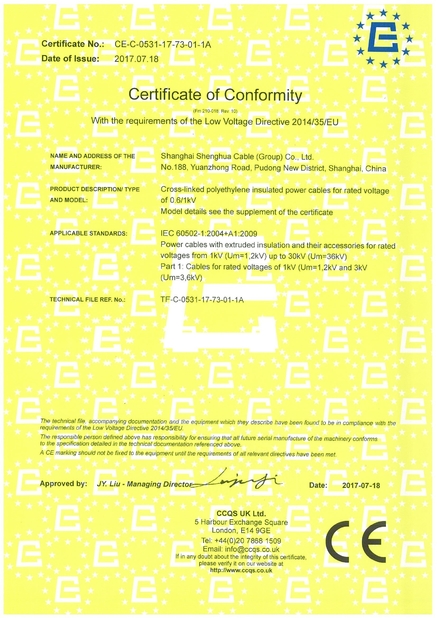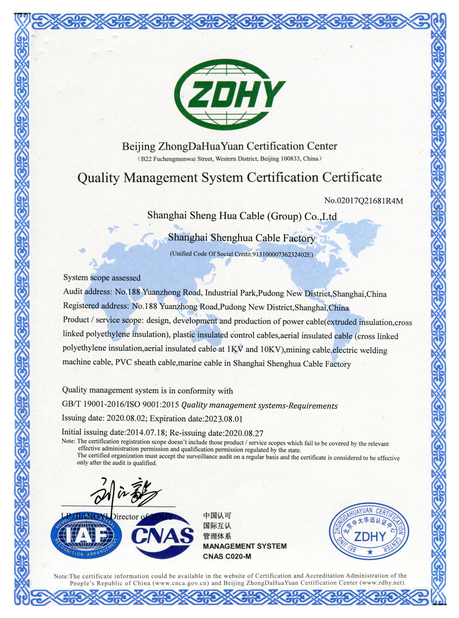
Shanghai Shenghua Cable (กลุ่ม) จำกัด
Tinned copper cable costs a little more per metre and lasts far longer in the places where ordinary copper fails first. A thin tin coating over each strand stops the oxide growth that turns bare copper green in humid air, keeps contact resistance stable in connectors, and prevents the black copper sulphide that forms when bare copper touches sulphur-cured rubber insulation. This guide explains how the coating is applied, what thickness and standards apply, and where tinned copper conductors genuinely justify the premium: marine and coastal installations, solar DC arrays, battery energy storage, submersible pumps and high temperature equipment. It ends with six direct answers on coating thickness, crimping, solderability and galvanic compatibility with aluminium.

A tinned copper conductor is a standard annealed or flexible copper conductor in which every individual strand has been coated with tin before stranding. The coating is applied either by electroplating, which gives a thin and very uniform layer, or by hot dipping, which gives a thicker layer suited to heavier conductors. Typical coating thickness is in the range of one to three micrometres, and the finished conductor is classified under ASTM B33 or the equivalent national standard, with the stranding and resistance defined by IEC 60228 class 2, 5 or 6 depending on flexibility.
The function of the tin is barrier protection, not conductivity. Tin is less conductive than copper, so a heavy coating slightly increases the overall resistance, which is why the standards place an upper limit on coating thickness and why a properly tinned conductor still meets the same resistance class as its bare equivalent. What the tin does is prevent oxygen and moisture from reaching the copper surface. Bare copper in humid air forms copper oxide and, in the presence of chlorides or sulphides, forms green or black corrosion products that increase contact resistance and eventually consume the strand.
| Property | Bare copper | Tinned copper |
|---|---|---|
| Surface oxide growth | Rapid in humid air | Effectively prevented |
| Corrosion in chloride environment | Green verdigris, pitting | Very resistant |
| Solderability after storage | Degrades within months | Retained for years |
| Contact resistance stability | Rises with oxide | Stable |
| Compatibility with rubber insulation | Black copper sulphide | No reaction |
| Cost | Baseline | Typically 3-8 percent higher |
The distinction between tinned copper and tin plated copper is largely one of trade language; both describe the same construction. What does differ is quality: a coating with pinholes or an uneven hot dip leaves exposed copper that corrodes from the inside, and the resulting failure is worse than with bare copper because the corrosion is hidden under a bright surface. Buyers should ask for a coating thickness specification and a continuity or adhesion test rather than accepting the word tinned.
The economic case for tinned copper conductor is straightforward once the failure mode is understood. Bare copper does not fail because it is a poor conductor; it fails because its surface changes. Every one of the following mechanisms is eliminated or greatly slowed by a tin coating.
1. Humid and coastal atmospheres. In a marine or coastal installation, airborne chloride deposits on the conductor surface and, with moisture, forms copper chloride complexes that progressively pit the strand. In a cable where the sheath is damaged or the termination is imperfect, this attack proceeds along the conductor and raises resistance at every crimp. Tinned copper is the standard answer, and it is why marine and offshore specifications almost universally require it.
2. Sulphur cured rubber insulation. Rubber insulated flexible cable is cured with sulphur compounds, and residual sulphur reacts with bare copper to form black copper sulphide at the interface. The result is adhesion between insulation and conductor and, in severe cases, strand embrittlement. Tinned copper is chemically inert to this reaction, which is why H07RN-F type cables and many industrial flexible cables use tinned conductors as standard.
3. Solar DC circuits. A photovoltaic array operates at high module temperature and is exposed to daily thermal cycling, humidity and, at many sites, salt spray. EN 50618 and IEC 62930 both recognise tinned copper as the reference conductor for PV cable, because the DC side cannot be de-energised during daylight and a corroded joint becomes a hot spot that is difficult and dangerous to service.
4. Battery energy storage and DC busbars. High current DC links in storage containers and inverter cabinets run warm and are frequently mated to aluminium or nickel plated hardware. A tinned copper conductor reduces galvanic mismatch at the terminal, keeps the contact resistance stable through thousands of cycles, and avoids the progressive heating that precedes thermal runaway in a loose joint.
5. Long storage and export logistics. A cable that spends three months in a humid container before installation will have an oxidised surface if it is bare copper. Tinned copper arrives solderable and crimpable, which matters most for flexible control and instrumentation cable where the installer must terminate many small cores.
Specify the conductor as tinned copper to ASTM B33, with the coating thickness or coating class stated, and require the resistance to comply with IEC 60228 for the relevant class. For flexible cable, class 5 or class 6 stranding should be stated explicitly, because the flexibility of a drag chain or a submersible riser depends on strand count rather than conductor area. Require a test report showing conductor resistance and, ideally, a coating continuity check.
Then match the termination to the conductor. Tinned copper crimps well with standard copper lugs, but the crimp die must match the actual conductor diameter rather than the nominal cross section, because tinned strands are slightly larger than bare copper strands of the same area. Where soldering is used, the tin coating improves wetting and reduces the dwell time needed, which protects the insulation from heat damage. In marine work, use tinned lugs or tin plated terminals so that the joint does not become the corrosion site, and apply a sealing compound or heat-shrink boot to exclude moisture.
Watch the galvanic couple. Copper and aluminium in contact with moisture form a galvanic cell, and the aluminium corrodes preferentially. Where a tinned copper conductor must be joined to an aluminium bar or lug, use a bimetallic transition plate or a connector listed for copper-to-aluminium use, and seal it. Tinning reduces but does not eliminate this effect, because the tin itself is cathodic to aluminium. The same logic applies at the interface with galvanised steel, where a proper connector and sealing are still required.
Finally, consider the whole construction rather than the conductor alone. A tinned conductor inside a sheath that admits water will still corrode, just more slowly. Pair tinned copper with water blocking in wet duty, with an XLPO or XLPE insulation in high temperature duty, and with a UV stabilised sheath in outdoor duty, so that the corrosion protection is not defeated by another weakness in the design.
| Application | Why tinned copper | Typical construction |
|---|---|---|
| Marine and offshore | Chloride corrosion | XLPE or rubber, tinned class 5 |
| Solar DC array | Humidity, thermal cycling | XLPO double insulated, EN 50618 |
| Battery storage | Contact stability at high current | Flexible XLPO, 1500 V DC |
| Submersible pump | Permanent immersion | Rubber sheathed, water blocked |
| Drag chain and robotics | Flex life and solderability | PUR jacket, shielded, class 6 |
| Rubber insulated flex | Sulphur reaction | H07RN-F, tinned class 5 |
Typical products in current production include the PUR jacket waterproof drag chain cable 4x1.5mm2 with tinned copper shield, the H1Z2Z2-K 1x6mm2 1500 V DC solar and storage cable, and the H1Z2Z2-K 1x4mm2 double insulated PV cable to EN 50618. Larger array strings use the H1Z2Z2-K 1x10mm2 1500 V DC cable, while the PV1-F 1x6mm2 tinned copper cable approved to TUV 2 PfG 1169 remains widely specified on older PV designs. For storage containers the 1x95mm2 1500 V flexible BESS DC cable carries the high current links, and off-grid lighting systems use the 1x2.5mm2 1000 V DC PV cable.
A tin coating is only useful if it is continuous. Three simple tests reveal most defects. The first is a coating thickness measurement by microscopic examination of a polished cross section, which shows whether the layer is within the specified range and whether it is uniform around the strand. The second is an adhesion test, in which the conductor is bent or wound around a mandrel of defined diameter and the coating is examined for flaking or cracking; a coating that lifts during stranding offers no protection at all. The third is a continuity or porosity test, often by chemical or electrochemical means, which detects pinholes that expose the underlying copper. A supplier who can present these three results for a production batch is demonstrating control of the process, not simply buying tinned wire from a trader.
There is also a practical field check. After storage, a genuine tinned conductor remains bright silver with at most a light dulling, while a poor coating develops brown or green patches at the strand ends and along the lay. Bending a short sample and looking at the strand surfaces under a magnifier takes a minute and is often enough to reject a doubtful delivery before it is installed.
The premium for tinned copper conductor is small, typically a few percent of the cable price for a standard construction and somewhat more for fine stranded flexible designs. The comparison that matters is not the purchase price of the two cables but the cost of the first failure. Replacing a failed PV string cable on a roof requires access equipment, isolation of the DC array during daylight, and often a partial re-lay; replacing a submersible riser requires lifting the pump. In both cases the labour cost is an order of magnitude larger than the material difference. For a marine or coastal project, the comparison is even more one sided, because a bare copper conductor inside a damaged sheath can be completely consumed by corrosion before anyone notices the fault. Approached as a life cycle decision rather than a unit price decision, tinned copper is normally the cheaper option in any wet, salty, sulphurous or high temperature installation.
No. In dry indoor installations with sealed terminations, bare copper performs well and costs less. Tinned copper is justified where moisture, chlorides, sulphur or high temperature are present.
Typically one to three micrometres, defined by the applicable standard such as ASTM B33. Thicker coatings are used for hot dip conductors, but excessive thickness raises resistance.
Marginally, because tin has lower conductivity than copper. Standards limit the coating thickness so that the finished conductor still meets its IEC 60228 resistance class.
Yes, with the correct die size. Because tinned strands are slightly larger, the die must match the actual conductor diameter rather than the nominal area.
It reduces but does not eliminate it. A bimetallic connector or transition plate and proper sealing are still required for a copper to aluminium joint.
Not always, but it is common. Tinning avoids the black copper sulphide reaction between bare copper and sulphur cured rubber insulation.
Tinned copper conductor is a small material change with a large effect on service life wherever moisture, salt, sulphur or sustained heat are present. Specify the coating and the standard, match the crimp die to the real diameter, use bimetallic connectors at aluminium interfaces, and pair the conductor with a construction that keeps water out. That combination turns a marginal saving on material into a much larger saving on maintenance. Shanghai Shenghua Cable Group manufactures tinned copper PV cable to EN 50618, BESS DC cable, submersible and drag chain cable with water blocking and XLPO insulation as required. Send your site conditions, voltage class and expected life through our contact page and our engineers will propose the conductor coating, stranding class and sheath system that fit the application.